The Rate Nobody Pays
I go back to the Cayman Islands most years. Every time I land, the island has changed a bit more: more capital coming in, more private jets than commercial flights at the airport, more construction going up. I usually stay with my friend and former employer Oliver, who used to run a delta neutral trading shop that I worked for on island. This trip was meant to be a break from work, just time to relax, write, and catch up with friends after a month of back-to-back conferences in New York and San Francisco.
Cayman is a tax-free jurisdiction, which is a big reason why it keeps growing the way it does. HNWIs keep relocating here, and infrastructure keeps catching up. It’s also very expensive: a single dish at a restaurant is easily $40 with gratuity, and spending $3k-$4k a month is normal. It’s a regressive taxation since everyone pays the same prices regardless of income.
The Discovery
I was buying my usual burrito bowl from Hurley’s, and when I went to check out, they asked whether I wanted to pay in USD or KYD. Cayman law lets you settle in either currency you like. I pay with a Wise card, and it turns out most tap-to-pay terminals simply block foreign cards from paying in KYD. You get forced into USD, at a worse rate.
That was odd enough to make me check the actual peg. KYD is pegged to USD by law at 1 KYD to 1.20 USD, a reciprocal rate of about 0.8333 KYD per USD. But the rate merchants and banks actually use sits closer to 0.82 on the buy side and 0.84 on the sell side, and a foreign card gets forced into a rate around 0.80. Do the math and USD paying customers are getting charged roughly a 417 bps premium on a currency that is supposedly fixed.
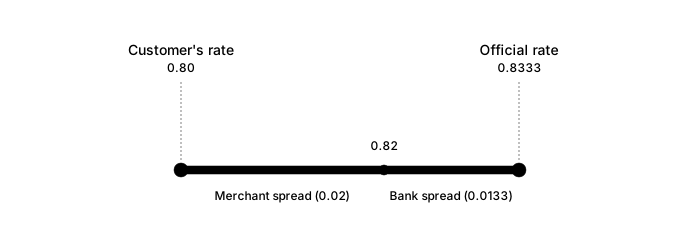
The bank’s buy rate is 0.82, so the merchant keeps up to 0.02, and the bank keeps at least 0.0133.
I wanted to know why, so I asked a friend who works at Cayman National how the system works internally. I learned that only Class A banks, roughly 9 to 11 of them on island, actually have the right to mint and redeem KYD for USD. Everyone else, merchants included, prices off whatever those banks quote. My contact mentioned a flat 25 cent government fee on conversions.1
So the government isn’t earning revenue from the spread directly. It’s bank revenue, and it’s basically guaranteed by the fact that only a small consortium of banks can set the rate at all.
It’s worth noting that Wise quotes the same 0.82 flat rate, since Wise sources KYD through the same retail bank channel as everyone else and has no wholesale access of its own. The near-peg rate is a bank to CIMA settlement relationship that the public can’t reach directly, since CIMA doesn’t do FX at all. Class B banks, a much larger group than Class A, are restricted to non-resident business only, so they can’t touch a local merchant’s payment at all.
Once I understood these mechanics, I wanted to figure out how to get customers a fairer rate. It turns out merchants aren’t all in the same position either. Some banks will share a kickback up to 0.82, letting the merchant capture that extra bit of spread themselves, while others settle merchants at 0.80 with no kickback at all, keeping the entire gap in-house. The customer’s rate is closer to a gentleman’s agreement than a fixed rate. I asked why merchants don’t compete on this, but nobody had a real answer beyond “that’s just how it’s done here.”
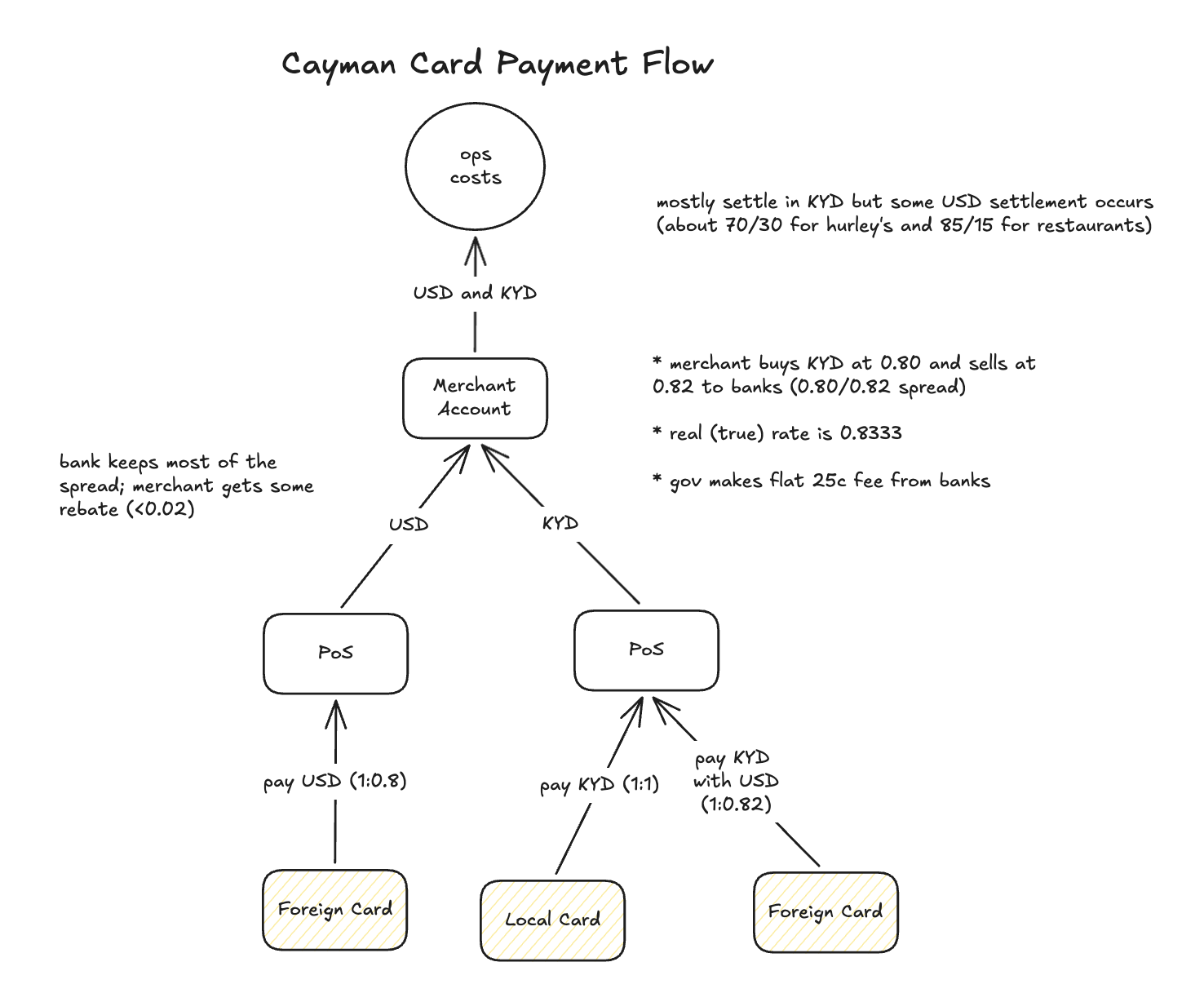
A foreign card forced into USD settles at 0.80 once the acquiring bank auto converts it into the merchant’s account. A foreign card paying directly in KYD instead gets the better 0.82 rate, and local cards pay KYD at par.
That reframed the question for me. Instead of asking how to get customers closer to par, I started asking whether merchants could capture more of the spread themselves.
Two Ways to Act on This
-
Get a Class A banking license and compete on rate directly. That takes real capital, roughly 300k CI to start and likely more in practice, plus years of ongoing CIMA supervision. It would also likely push the existing consortium to compete down to match me, which helps merchants and customers but kills my own margin fast.
-
Run a treasury netting service between merchants instead of trying to become a bank. Some merchants take in mostly USD, from cruise ship traffic for instance, and need KYD for local costs like labor. Others need USD to pay overseas suppliers and are sitting on KYD. Right now, each side just swaps through the acquiring bank on its own, eating the spread every time.
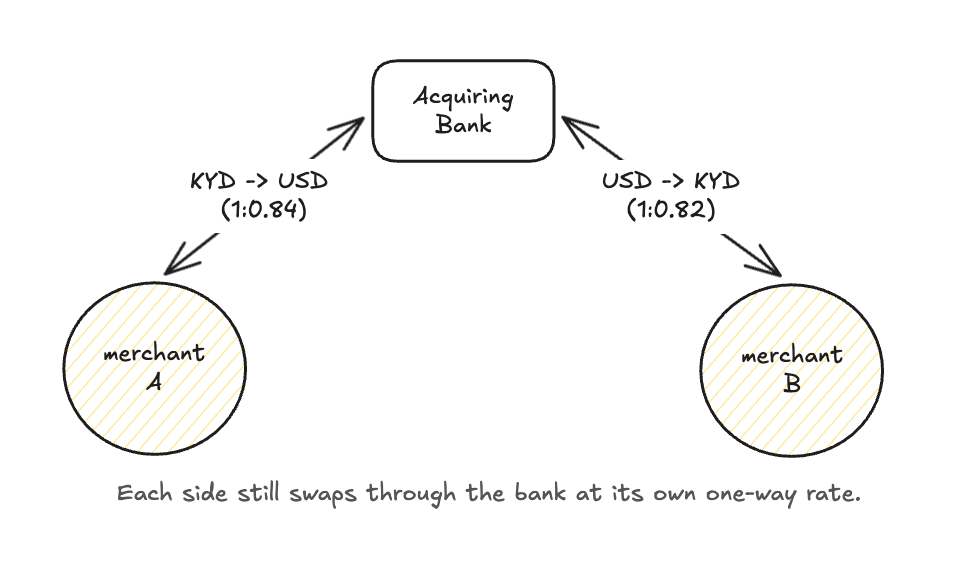
Today, every merchant swaps through the acquiring bank on its own, KYD to USD at 0.84, USD to KYD at 0.82, eating the bank’s one-way spread on every transaction.
If I can match those two sides directly instead, a coincidence of wants, both merchants settle near the peg. A merchant doing $1.5m a month in USD turnover could plausibly keep something like $10k-$20k KYD a month that would otherwise sit in the bank’s spread.2
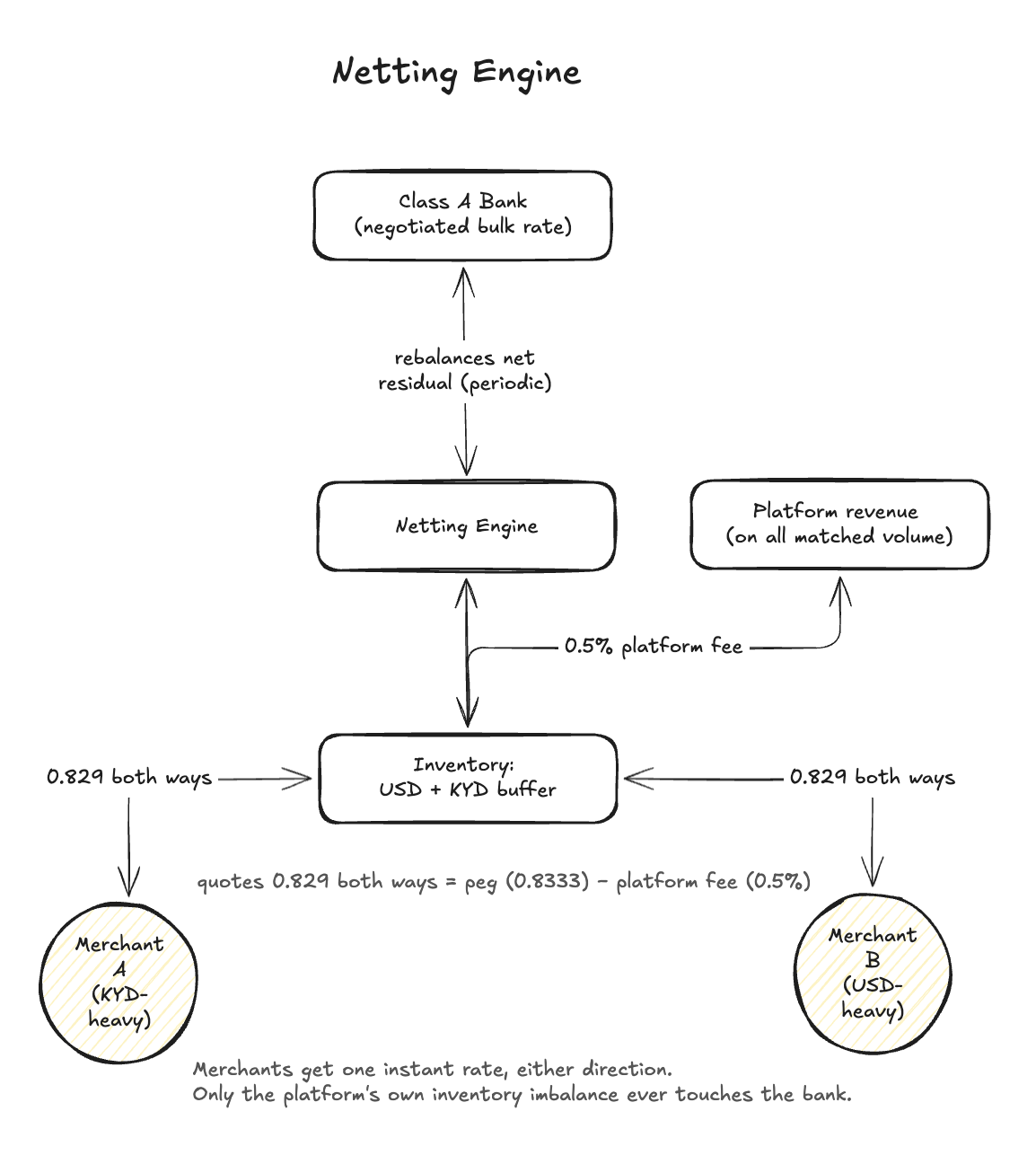
Merchants swap against a shared USD/KYD inventory at one symmetric rate, 0.8333, the peg minus the platform’s 50 bps fee, instead of the bank’s separate 0.82/0.84. The platform earns that fee on all matched volume; only the inventory’s own net imbalance ever touches a Class A bank.
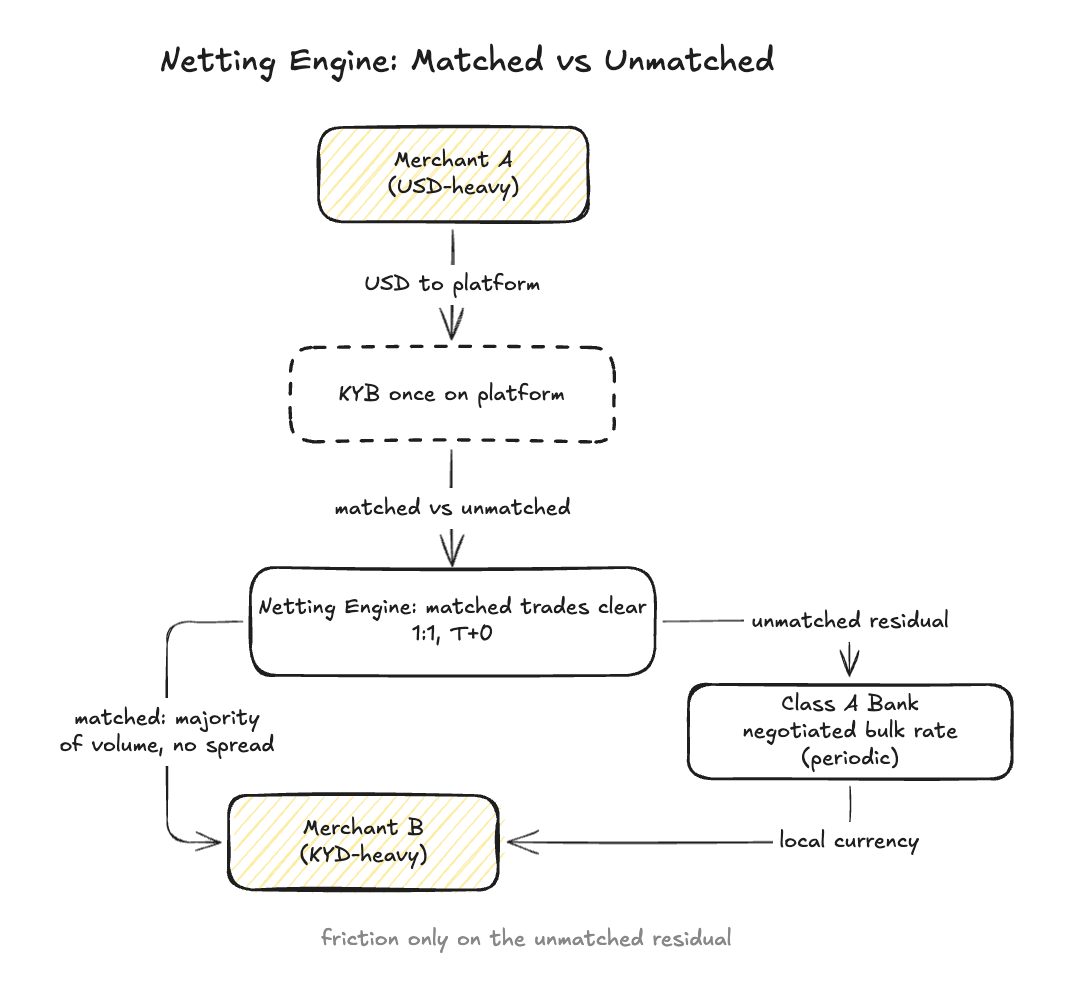
Funds hit the platform and get KYB’d once. From there the engine splits volume into matched, which settles 1:1 at T+0 with no spread, and unmatched, which sweeps periodically to a Class A bank at a negotiated bulk rate before reaching the other merchant.
This second path needs an MSB license instead of a full banking license, lower starting capital, and a negotiated relationship with a Class A bank to cover whatever volume doesn’t get matched. The main problem is that the Caymans requires majority Caymanian ownership and control (60%) for most local businesses, and a banking license happens to be one of the few categories exempt from it. An MSB license isn’t, so this path solves the rate problem but leaves ownership completely open, something I’d have to sort out separately, most likely through a genuine Caymanian ownership partner or a slower Local Companies Control License (LCCL) process.
| Banking license | Netting service | |
|---|---|---|
| Vehicle | Banks and Trust Companies Act | Money Services Act |
| Starting capital | ~300k CI, likely more in practice | CI$30,000 minimum |
| Timeline | Years, ongoing CIMA supervision | Weeks |
| 60/40 ownership rule | Exempt automatically | Not exempt, stays open |
| Biggest risk | Capital cost, incumbents compress margin | Cold start matching, ownership unresolved |
What’s Still Unresolved
A banking license is slow and capital heavy, but it has no ownership issues. The netting model is faster and cheaper to license, but leaves ownership completely open, and only works if there’s enough matched volume on both sides from day one. Otherwise the unmatched residual ends up bigger than what actually gets netted, and I’m back to eating the bank’s spread on most of it anyway.
Cayman is small, and its financial sector is a tight, established group. The government doesn’t collect this spread directly, but indirectly via license fees, compliance fees, import duties, etc — all downstream of a financial sector that stays healthy partly because margins like this exist. An MSB application whose whole point is compressing that spread is a hard sell to the same government that benefits from it staying wide.
One way around that is applying under a different licensed activity, framed as adding FX volume rather than capturing spread, and staying under a threshold low enough to avoid attention. Unfortunately, this model doesn’t scale and would likely get shut down the moment it draws suspicion; it’s an island after all.
I was supposed to be on vacation, and I got the beach time in, mostly. I just couldn’t leave this alone once I delved into the mechanics. Given the regulatory grind, and the fact that the government has its own reasons not to touch this, I doubt it’s worth chasing much past the research stage. I hadn’t seen any of this documented anywhere, so it felt worth putting down properly in writing. Cayman is small enough, and run by few enough people, that something like this can sit unexamined in plain sight. If you want to take this further, or know someone who would, I’d like to hear from you.
Everything above is general research pieced together from public sources and conversations with contacts on the island, not a legal opinion on any specific structure. Anything involving real licensing or ownership needs direct review by a Cayman corporate lawyer before it goes further than this.